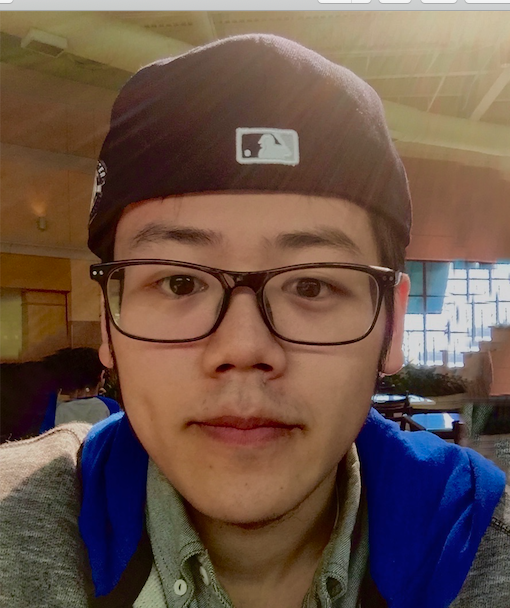
Cunwei Fan (范存炜)
I am a Quantitative Research Scientist at Quantlab Financial, where I work on systematic equity trading research. Before stepping into finance full time, I spent eight years at the University of Illinois Urbana-Champaign earning a Ph.D. in physics, with detours through string theory, computational general relativity, and high-energy experiment along the way.
I am, at heart, a modeler. Physicists tend to capture the world by writing down Lagrangians and arguing from symmetry; statisticians and machine learners capture it by letting the data carve out the structure for them. I have spent the last decade moving fluently between the two — using deep networks to disentangle subtle signals at the LHC, borrowing variational principles from quantum mechanics to attack molecular energies, and, more recently, applying the same instincts to financial markets, where the underlying “physics” is noisy, adversarial, and stubbornly non-stationary.
Education
Ph.D. Physics — University of Illinois Urbana-Champaign
- August 2017 – July 2025, Urbana, IL.
- Advisor: Benjamin Hooberman.
- Dissertation work spanned two threads: (i) machine-learning–driven searches for new physics at the ATLAS detector, including lepton isolation and displaced-lepton analyses powered by sequential neural networks (RNN, LSTM); and (ii) the AdS/CFT correspondence, where I derived implications of boundary entanglement constraints for bulk gravitational theories.
B.Sc. Mathematics & B.Sc. Physics — University of Illinois Urbana-Champaign
- August 2013 – May 2017, Urbana, IL.
- Physics GPA 4.0/4.0; Mathematics GPA 3.97/4.0.
- Cum Laude (2017); recipient of the Ernest M. Lyman Prize and the Yee Seung Ng Scholarship.
- Undergraduate research with Professor Stuart Shapiro on numerical relativity and relativistic magnetohydrodynamics of compact binaries.
Work Experience
Quantlab Financial, LLC. — Quantitative Research Scientist
- September 2023 – Present, Houston, TX.
- Quantitative research across a range of equity trading horizons, spanning signal generation, model development, and the surrounding data and evaluation infrastructure. Project specifics are kept confidential.
JP Morgan Chase — Quantitative Research Intern
- June 2023 – August 2023, Plano, TX.
- Built a linear model to forecast the monthly charge-off rates of loan accounts.
Quantlab Financial, LLC. — Quantitative Research Intern
- May 2022 – August 2022, Houston, TX.
- Equity signal research on daily-horizon return prediction across a broad universe of U.S. names. Project specifics are kept confidential.
Barclays Investment Bank — E-trading & Machine Learning Intern
- June 2021 – August 2021, New York, NY.
- Predicted closing prices from closing-auction order-book data.
ByteDance AI Lab — Research Scientist Intern
- February 2021 – May 2021, Beijing, China.
- Incorporated effective-core-potential methods into FermiNet for ab initio quantum chemistry; implementation in PyTorch and JAX.
Publications
-
SciCode: A Research Coding Benchmark Curated by Scientists. NeurIPS. Contributed to the benchmark design — a scientist-curated, stepwise evaluation of large language models on multi-step research problems — and helped curate, validate, and certify problems, gold solutions, and test cases in physics.
-
Search for Displaced Leptons in √s = 13 TeV and 13.6 TeV pp Collisions with the ATLAS Detector. Physical Review D. Led the machine-learning component and contributed to the physics analysis used to filter displaced-lepton candidate events.
-
Li, X., Fan, C., Ren, W., Chen, J. Fermionic Neural Network with Effective Core Potential. Physical Review Research 4, 013021 (2022). Modified FermiNet by exploiting physical symmetries and effective core potentials, dramatically reducing the cost of treating transition-metal systems.
-
Fan, C., La Nave, G., Phillips, P. W. Second-Order Lovelock Gravity from Entanglement in Conformal Field Theories. Physical Review D 104, 126018 (2021). Extended the derivation of bulk gravity from boundary entanglement to second order, recovering Lovelock gravity as the natural successor to Einstein’s equations.
Activities
- DSECOP Fellow — contributed data-science tutorial material for physics students through the DSECOP Fellowship.